
CPSC new rule in effect|Certificate selection|eFiling declaration|Practical guidance for companies
Bottom line first
|
|
Expressions to avoid ● “CPSC officially issues the certificate,” “CPSC-approved product,” or “lab issues the CPSC certificate” are misleading. ● Better phrasing: the product completes applicable regulatory testing, the responsible party issues a CPC or GCC, and the certificate data is submitted as required at import. |
-
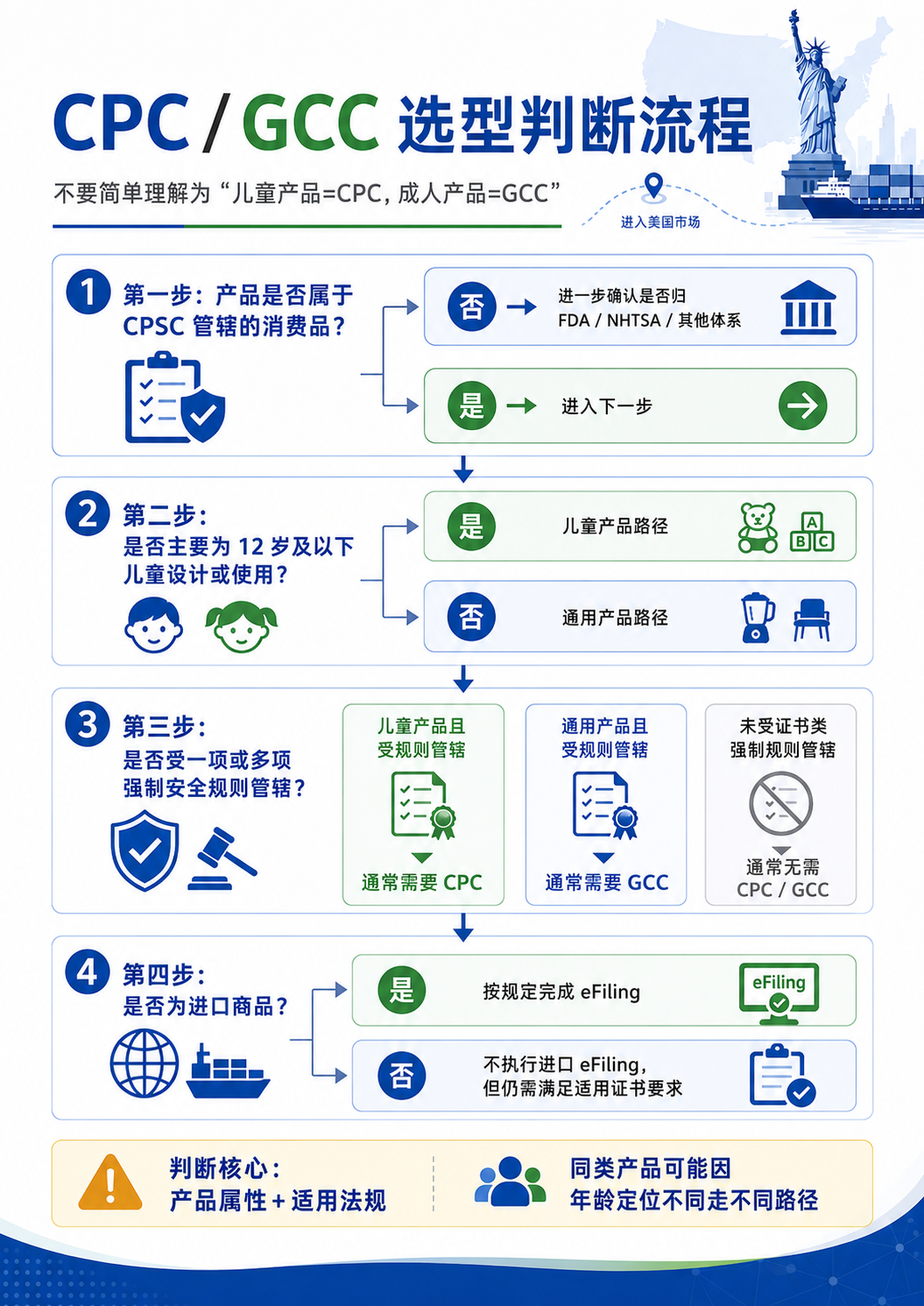
Children’s product + children’s safety rule → usually CPC.
-
General product + applicable CPSC mandatory rule → usually GCC.
-
General product not caught by any certification-requiring mandatory rule → do not? invent a GCC just for “safety.”
|
Item
|
CPC – Children’s Product Certificate
|
GCC – General Certificate of Conformity
|
|---|---|---|
|
Applies to
|
Primarily for children ≤12 and under children’s product safety rules
|
Non-children’s general products under CPSC mandatory rules/bans/standards
|
|
Testing basis
|
Applicable third-party-tested items generally must be tested by a CPSC-accepted lab with coverage for those items
|
Based on testing or reasonable testing program; CPSC-accepted lab not universally required unless rule specifies
|
|
Test scope
|
By product category, age, material, structure, use—no fixed universal package
|
By product-specific rule—no fixed universal package
|
|
Issuing responsibility
|
Responsible legal party per regulation; lab assists but does not replace
|
Same
|
|
Labeling
|
Usually children’s product tracking label + specific warnings/exemptions
|
Per product rule, origin, safety warnings; no uniform children’s tracking label duty
|
|
eFiling
|
Required for imports that legally need a CPC
|
Required for imports that legally need a GCC
|
|
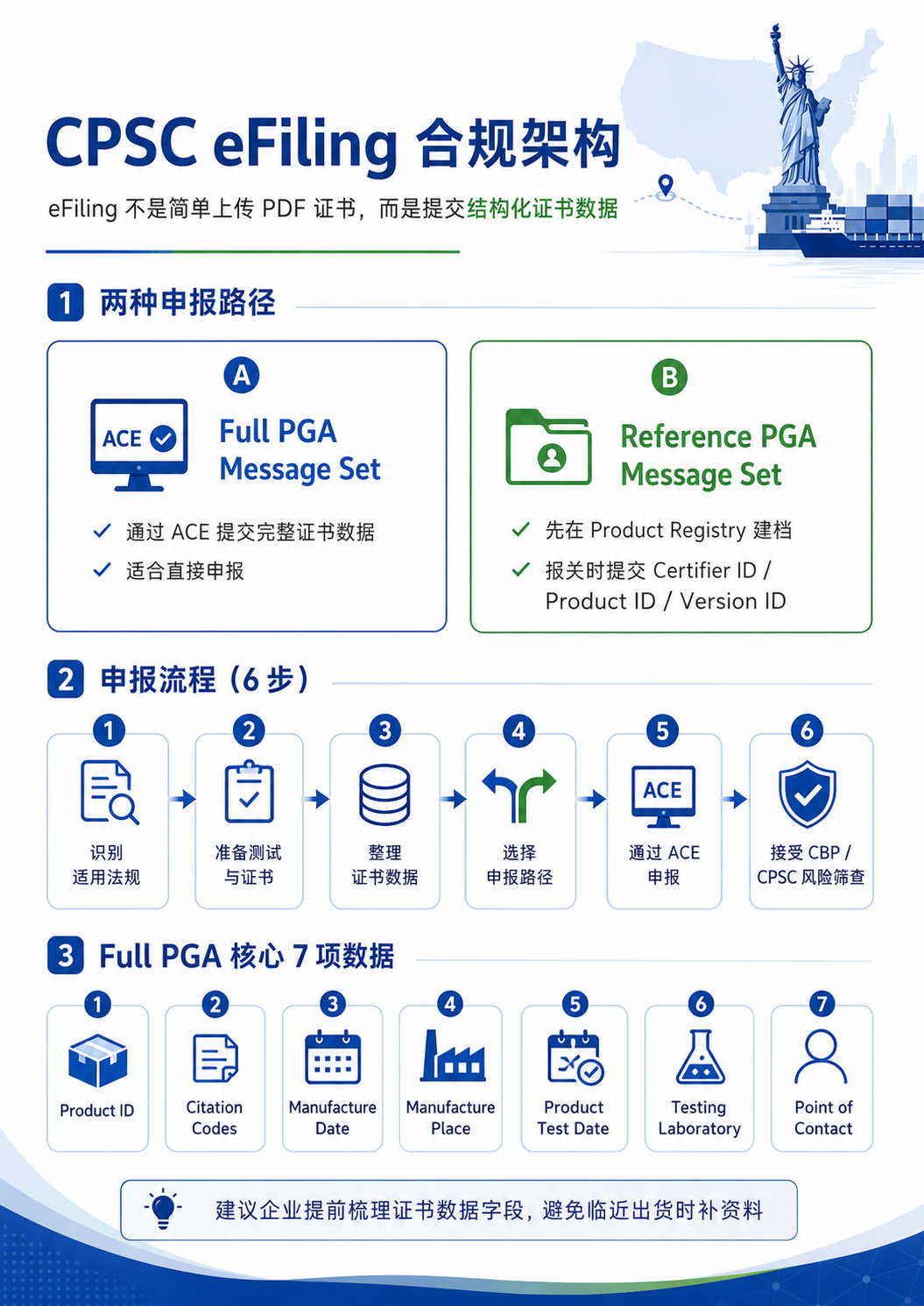
A |
Full PGA Message Set: Importer gives the broker seven required certificate data elements; broker submits the complete CPSC PGA message via ACE. Does not require CPSC Product Registry. |
|
B |
Reference PGA Message Set: Importer first builds and certifies product certificate data in the CPSC Product Registry, then gives the broker three identifiers at entry: Certifier ID, Product ID, Version ID. The Product Registry does not auto-sync to ACE; the broker still submits the reference message in ACE. |
|
1 |
Product ID:unique product identifier (model, SKU, UPC, GTIN, etc.) |
|
2 |
Citation Codes:CPSC regulation codes the product complies with, accurately mapped |
|
3 |
Manufacture Date: production date |
|
4 |
Manufacture Place:most recent test date supporting certification |
|
5 |
Product Test Date:actual lab/testing entity, matched to applicable regulation |
|
6 |
Testing Laboratory:actual lab/testing entity, matched to applicable regulation |
|
7 |
Point of Contact:person responsible for retaining test records and providing them |
|
Early eFiling phase: “not rejected yet” ≠ compliant ● CPSC has stated that initially it will not ask CBP to deny entry solely for missing Full/Reference PGA data; ACE may issue warnings. ● But certificate data affects risk scoring; CPSC continues to enforce certificate requirements and can seek examination, detention, seizure, or other action. ● So “the system didn’t bounce it” is not a transition-period exemption. |
- ypical CPC-path productsToys and some children’s activity items; cribs, play yards, pacifiers; children’s jewelry, stationery, clothing, sleepwear; other products primarily for ≤12 and under children’s rules.Typical GCC-path productsBicycles and bike helmets; mattresses, carpets, rugs; apparel flammability, lighters, bunk beds; non-children’s products with button/coin batteries under 16 CFR Part 1263, etc.Electronics are not automatically exempt“It’s an electronic product” is not a CPSC exemption. Electronics may also trigger FCC, NRTL/UL, plus CPSC questions on children’s rules, button-cell safety, flammability, packaging, etc. Different regimes do not substitute for each other.
|
Example: button-cell product
|
|
1 |
Judging age by product name only – ignoring size, packaging, ads, channel, consumer perception. |
|
2 |
Treating children’s-product testing as a fixed menu – blindly using “total lead + phthalates + small parts + ASTM F963” may miss items or add irrelevant ones. |
|
3 |
Checking lab accreditation but not CPSC scope – being on the CPSC list does not cover all children’s-item tests. |
|
4 |
Citing only standard names – certificates and eFiling need accurate Citation Codes, not “ASTM F963” or “flammability test” alone. |
|
5 |
Letting certificate, report, label, and physical unit drift – mismatched model, brand, manufacturer, address, dates, identifiers trigger scrutiny. |
|
6 |
Treating eFiling as PDF upload – it is structured data; Reference PGA still needs three IDs in ACE. |
|
7 |
Pushing all responsibility to the broker – broker submits data; product characterization, regulation ID, test basis, and certificate content must be prepared and confirmed by the company and responsible party beforehand. |
-
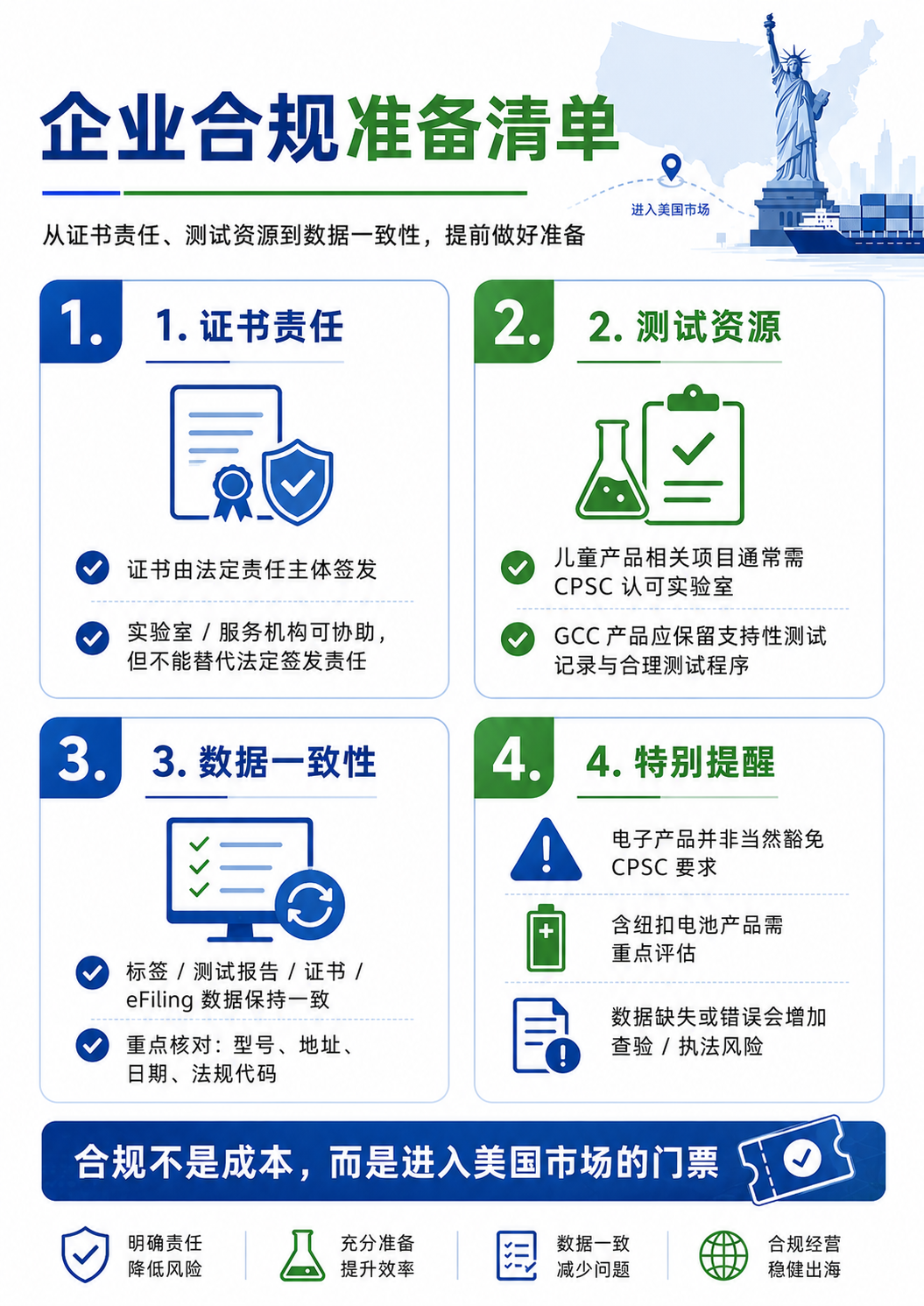
1.Product-regulation determination table? – per product series: target age, use scene, material/structure, applicable rules, certificate type, test items, labeling, eFiling path; re-review on marketing/packaging change.
-
2.Fix the certificate responsible party early? – in PO, brand license, import arrangement, broker engagement: who is the statutory certifier, who keeps test records, who feeds data to broker.
-
3.Match testing resources to path? – CPC: verify CPSC-accepted lab and scope; GCC: build traceable test basis / reasonable program; document any exclusion, exemption, or component-test reliance.
-
4.Build a certificate data master file? – Product ID, citation codes, manufacture date/place, test date, lab, record-keeping contact; align with ERP, orders, broker docs, Product Registry.
-
5.“Four-way consistency” check? – physical product & label ↔ test report ↔ CPC/GCC ↔ eFiling data (brand, model, identifiers, manufacturer/importer, address, dates, regulations, lab).
-
6.Change control? – on material, structure, supplier, software, brand, model, packaging, age positioning, or production site change: decide if retest, certificate update, Registry version bump, or declaration update is needed.
|
Hongbiao Certification suggestions ● Before U.S. market entry, complete five diagnostics: product attribute + applicable regulation + certificate type + testing resource + eFiling path. ● For multi-model, multi-brand, multi-importer, or recurring-shipment programs, build a standardized certificate data master and version-control mechanism. ● For case-by-case CPC/GCC calls, test plans, certificate review, or eFiling data mapping, use a professional compliance team. |
• CPSC|Certificates of Compliance and eFiling
• CPSC|eFiling Frequently Asked Questions
• CPSC|Children’s Product Certificate
• CPSC|General Certificate of Conformity
• CPSC|Rules Requiring Third-Party Testing and a CPC
• CPSC|Rules Requiring a GCC
• Federal Register|Certificates of Compliance, 90 FR 1800
▼▼▼欢迎联系非凡国际!▼▼▼
HONGBIAO
- Contact:0755-29989321
- WeChat: 18098971410
- Email: sales@sz-hongbiao.com
- Web:
- Address: 102, 201, Building 2, Invengo RFID Industrial Park, Tongguan Road, Tianliao Community, Yutang Street, Guangming District, Shenzhen, China
